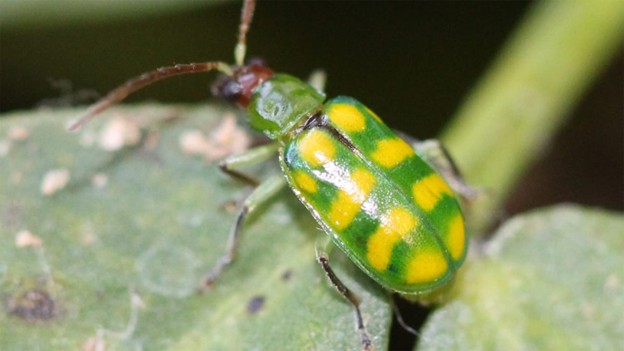
The banded cucumber beetle (picture below) has given us some fits over the past few years, and finally, we have something for it. The Georgia Department of Agriculture recently approved a Special Local Need (24c) label for the insecticide Vertento (Isocycloseram) for rootworm management in peanuts in Georgia. The 24c label allows Vertento to be applied in-furrow at planting. University of Georgia trials over multiple years at the Southwest Research and Education Center in Plains, GA, showed that in-furrow, at-plant applications of the active ingredient in Vertento consistently reduced pod injury caused by rootworm larvae. Vertento can also be applied through center pivot irrigation systems for rootworm management in peanuts. This use pattern has been very effective at reducing rootworm injury in research trials. If you choose chemigation rather than, or in addition to, an at-plant application, you need to ensure the irrigation system is set up appropriately. The main thing here is uniformity. There is still a lot to learn about managing rootworm with Vertento, but getting the active ingredient into the soil where the pest lives is important. We have not tested every possible use pattern nor have we conducted trials in multiple environments, but Dr. Abney has enough work and data to be confident in Vertento’s efficacy against rootworm when used in-furrow at-plant and when properly applied in irrigation water. Some have asked about making a foliar application and immediately turning on the pivot to try and wash the insecticide to the soil. One characteristic of the active ingredient in Vertento is that it stays where you put it. It does not readily leach out of the soil, and it does not readily wash off the plant. I strongly recommend that you stick with the use patterns that have been tested and shown to be effective: in-furrow at-plant and chemigation. As with all pesticides, read and follow label instructions.