Milkweed, in the genus, Asclepias, are the prime host plants for monarch butterflies. Their caterpillars feed exclusively on milkweed leaves. Without milkweed, monarchs cannot complete their life cycle. The monarch has long been the most fascinating insect in the United States. Not only is it a beautiful butterfly, but it also undertakes the longest and most remarkable migration of any insect species on earth.

In the Piedmont region of Georgia, there are four species of milkweed that are commercially available and that are beneficial to Monarchs.

- Swamp Milkweed (Asclepias incarnata) is a clump-forming perennial that likes wet and evenly moist soils as about the light, it prefers full sun to light shade. Plants typically reach 90–150 cm (3–5 ft) and bloom mid–late summer with pink to rose flower clusters that draw butterflies, bees, and other beneficial insects.
- Plant in a site that stays moist (rain garden edges, low swales, pond margins). Work in compost to improve water retention but avoid heavy fertilizer. Space 45-60 cm (18-24 in) for airflow. Deadhead to extend bloom, then leave late-season seedpods for winter for wildlife.
- Butterfly Milkweed (Asclepias tuberosa), Butterfly Weed, is most often a distinctive bright orange, but there is variation in flower color, from deep red orange to yellow. This distinctive color and the absence of the typical milky white sap that other Milkweed species have make identification easy. The leaves are somewhat narrow, up to 1” and tapered, with no stem and dark green in color.
- This is a great Milkweed for a sunny location in a dry area. Mature plants in ideal locations can make as many as 20 stems at an average height of 2’. The vivid orange color, low mounded profile, and ability to attract and sustain butterflies make this plant a well-known landscape favorite for all types of gardens. Like all species in the Asclepias genus, Asclepias tuberosa is one of the larval host plants for the monarch butterfly.
- Butterfly Weed needs a drier, well-drained location to successfully seed and grow well. In older plants the long tap root can extend down many feet. Due to this deep, drought-tolerant tap root, it can emerge late in the spring, especially in northern climates, so be patient. Butterfly Weed can be transplanted if dug carefully during dormancy, but if the tap root breaks off, they will regrow.
- Whorled Milkweed (Asclepias verticillata) has very skinny, “whorled” leaves. When Whorled Milkweed is mature it reaches a height around 2′. Whorled Milkweed is deer and rabbit resistant. Please note that this species is rhizomatous and will spread.
- Whorled Milkweed can bloom anytime between July and September, which is later in the year than many other Milkweeds. There are clusters of approximately 20 flowers near the top of each plant. The white flowers can be greenish white on some plants. The nectar of the flowers attracts many kinds of insects, including long-tongued bees, short-tongued bees, wasps, flies, butterflies, skippers, and beetles. Like all members of the Asclepias genus, Asclepias verticillata is a larval host plant for monarch butterflies.
- Smoothseed Milkweed or Smooth Seed Milkweed (often known as Asclepias sullivantii or Prairie Milkweed) is a highly valued native perennial. It features completely smooth (hairless) leaves, prominent pink midveins, and showy, globe-shaped clusters of pink flowers. It is significantly less aggressive than Common Milkweed and serves as a vital host plant for Monarch caterpillars.
You should avoid Tropical Milkweed (Asclepias curassavica), a non-native milkweed. Tropical milkweed becomes a problem when planted in temperate areas where it does not die back in winter. A protozoan parasite of monarch butterflies, Ophryocystis elektroscirrha or OE for short, can travel with monarchs visiting the plants and become deposited on leaves. When caterpillars hatch and start eating the plant, they ingest the OE. High OE levels in adult monarchs have been linked to lower migration success in the eastern monarch population, as well as reductions in body mass, lifespan, mating success, and flight ability.
In addition to planting native milkweed host plants for monarch caterpillars, it is also important to plant nectar-rich plants for adult monarchs. Adult monarchs are dependent on nectar plants as a food source during spring and summer breeding, fall migrations, and during overwintering.
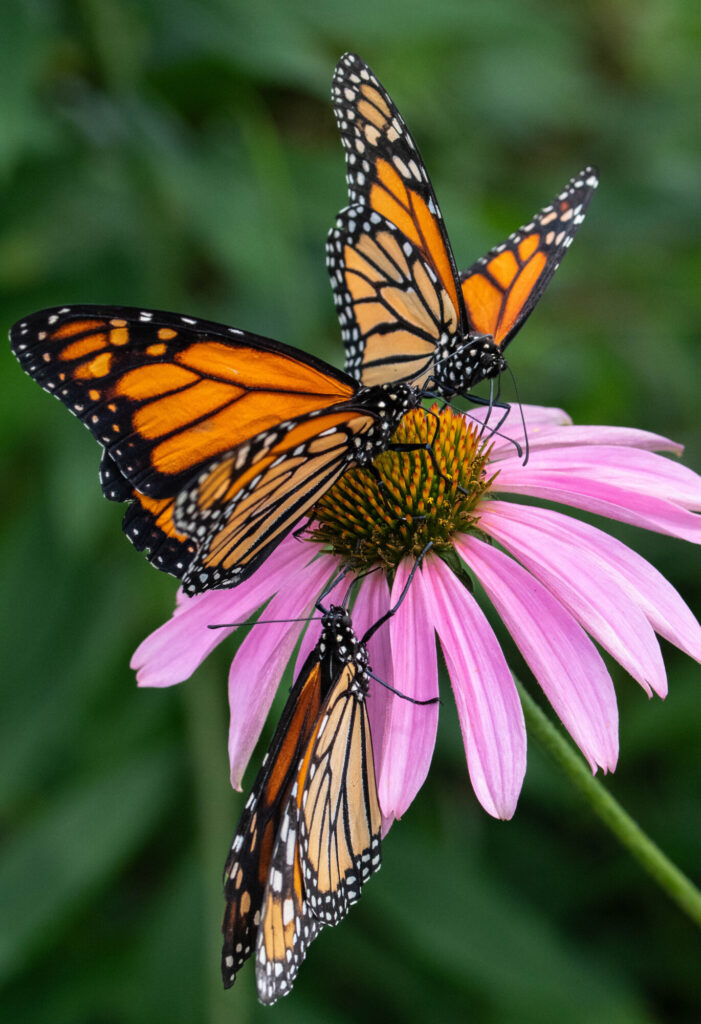
The Xerces Society, in partnership with the National Wildlife Federation and Monarch Joint Venture, developed regional monarch-specific nectar plant guides for the continental US. The plant species included in these nectar plant guides are based on monarch nectaring observations compiled from numerous sources, including published and technical reports, research datasets, and personal communications with monarch researchers, botanists, and other experts.
- Spring/Summer: Milkweed varieties (like Butterfly Weed and Swamp Milkweed), Purple Coneflower, Wild Bergamot, and Blazing Stars
.
- Late-Summer/Fall: Goldenrods, Asters, Joe-Pye Weed, and Mexican Sunflowers.
Monarch butterflies are often seen as symbols of transformation and rebirth. In many cultures, butterflies represent the soul or spirit of loved ones.
Other resources:
State Botanical Garden of Georgia
USDA Teacher Resources for Monarch Education
Xerces Society Regional Pollinator Plant Guides
The author of this article, Phillip Prichard, is a Paulding UGA Extension Master Gardener and Master Naturalist, trained to provide education for homeowners on horticulture, sustainable landscaping, and environmentally friendly gardening practices using unbiased, research-based information from the University of Georgia. For more information, contact Paulding County UGA Extension at 770-443-7616 or view our online resources at www.ugaextension.org/paulding.