Drought/Dryland Peanut Herbicides – Prostko
1) Residual herbicides must have moisture to be “activated”. Activation simply means the movement of the herbicide into the upper 1″-2″ of soil. This is the depth where most annual weeds emerge from. Moisture is also needed to keep the herbicide in the soil solution so that it can be absorbed into germinating weed roots and shoots.
2) In dry conditions, mechanical incorporation will improve the chances for success of some residual herbicides but is not a 100% guarantee under extreme drought conditions. In a drought, herbicides such as Prowl or Sonalan can be more tightly adsorbed onto soil colloids which makes them less available for plant uptake. If a grower is mechanically incorporating a herbicide and he cannot see the implement behind him because of the dust cloud, its very doubtful that incorporation will matter.
3) Since most residual herbicides only last on the ground for about 7-10 days (~14-17 days for Valor) before they must be moisture activated, it might be a good idea in dryland fields to go “naked” (no PRE) at planting. Wishing/hoping that more reliable rainfall is in the future? It costs roughly $20-23/A for the UGA standard PRE program of either Prowl or Sonalan (32 oz/A) + Strongarm (0.225 oz/A) + Valor (3 oz/A). So if it does not rain and these fail to perform, that’s good money lost!
4) A strong “naked” weed control program would include an “AT-CRACKING/EPOST” application of Gramoxone + Storm (brand name or home-made) + a Group 15 herbicide (Anthem Flex, Dual Magnum, Enversa, Outlook, Warrant, or Zidua: FYI, I have no preference here) followed by a timely “POST” application of Cadre + Cobra + 2,4-DB + Group 15. But, a grower must be ready to pull the trigger in these fields that have no PRE. There can be no delay!!
5) I do believe that since Valor does last a little longer without moisture activation and is super cheap (~$1/oz), that it might be worth the risk (cheap insurance)?
Peanut Planting Considerations – Monfort
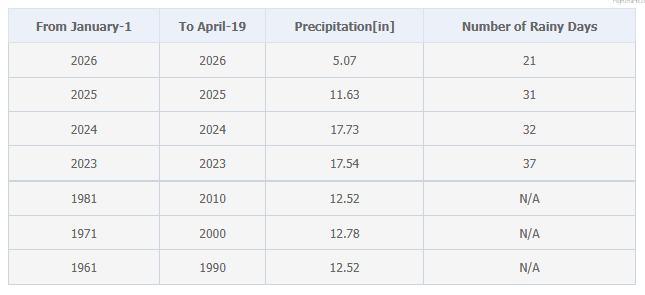
It has been hot and dry for the last several weeks. Growers need to be mindful of the moisture in the fields being planted. For the non-irrigated fields, the soil profile is DRY!!! The rain we received a week or so ago will not be enough to germinate the seed and allow them to emerge consistently. The seed is too expensive to put in dry soil and hope for rain. Keep the seed in the bag and wait for better conditions. In irrigated fields, it would be good to ensure the soil profile is well-moistened prior to planting. Try not to plant in dry, hot soil and irrigate after planting. This could shock the seed and cause uneven emergence. It is always better to irrigate before and after planting when temperatures are high and dry, as they are currently.
Cotton Planting Considerations – Hand
Thankfully for cotton, we are still early in the planting window. Normally we are getting started in mid-April, but I did get some reports during the first week of April of some cotton going in following a rain just so dryland guys could take advantage of moisture. I had a similar idea and planted about 7 acres of dryland on 4/10. In that situation, we deepened up significantly so the seed was below moisture, and as of the Monday after planting we were looking good, but still had some time to go.
All of this to say is yes, we can deepen up to avoid hot conditions, or put seed in moisture if there is any, or consider planting larger seeded varieties, but we are still early in the planting window for cotton and it is not time to push the panic button yet!!! Right now, the most critical piece to getting a stand in my mind is watering an irrigated field before you start planting, to ensure you put the seed in good, clean moisture. Then follow up with additional irrigation within a few days of planting. For dryland, have your finger on the trigger and be ready to go when the opportunity presents itself – or in other words “be sitting on go” when we catch a rain.
Sparks Weather Station Data