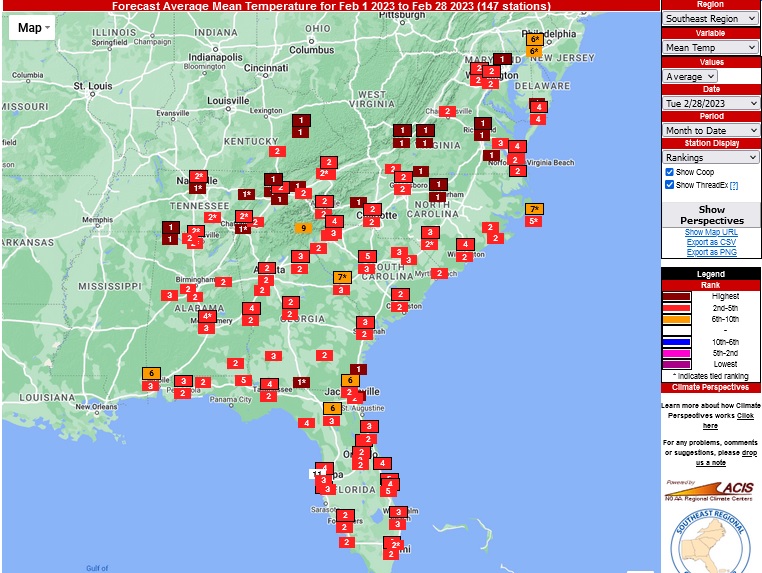
With just a couple of days to go, we can use the Southeast Regional Climate Center’s Perspectives tool to predict the ranking of temperatures for stations across the region. The tool, which you can find at https://sercc.com/climate-perspectives/, allows you to use predicted temperatures for up for five days ahead to predict the expected monthly average temperature and use that to rank the month against other months in the historical record. The map shows that most stations are ranked 2 to 3, with some stations reported the likelihood of a new warmest February on record.
I have picked both Coop stations and ThreadEx stations, which explains why many locations have two rankings. The ThreadEx records link historical city and airport records for National Weather Service offices with the longest record to allow comparisons over the longer time period. Keep in mind that ThreadEx records often show changes in climatology due to moves from the warmer cities to the cooler airports, but they are useful for citing records to media interested in the total city record.
If you are interested in a particular city, you can click on the appropriate ranking box to go to the page for that station. That will allow you to view all the years of data in a table that can be sorted to show which years were the warmest. For Athens, GA, it looks like we will be 3rd warmest February in the 166 years if the historical records in ThreadEx, with the warmest in 2018 and the second warmest in 1927.