Hunt Sanders
The end of this year’s row crop season is coming to an end very quickly. Before we know it, we will be harvesting cotton and getting peanuts on the ground. Though we are nearing the finish line, there is still plenty of time for problems to develop. Now is NOT the time to “let it ride.”
Jassid populations have started to pick up on the east side of the county. If you have terminated irrigation on your cotton and are still below threshold (1 jassid per leaf), you should not need to spray. Continue to scout and keep an eye on those populations as we move toward harvest.
Also, keep a close eye on your peanuts. We do not want a last-minute flight of moths coming into fields and laying enough eggs to result in threshold worm populations that could quickly strip foliage from our peanuts. We are getting close to the finish line, but protecting the crop through the final stretch is still important.
I have started conducting peanut maturity checks. If you would like to have a field checked, give me a call and we can take a look.
Reminder: I will be in Rochelle conducting peanut maturity checks for Wilcox County every Tuesday and Thursday.
- Extension Peanut Meeting on 9/11
- What am I seeing on peanut maturity boards?
- Finalizing Peanut Fungicide Programs (Dr. Bob Kemerait, UGA Plant Pathologist)
- Finalizing Cotton Irrigation (Dr. Wes Porter, UGA Precision Ag and Irrigation Specialist)
- Soybean Harvest Aids, Classic/Florida Beggarweed/Peanuts (Dr. Eric Prostko, UGA Weed Specialist)

I started checking peanuts in Rochelle yesterday. What have I seen so far?
Remember that DG 913 is supposedly 3-5 day earlier maturing than 06G. GA 09B is a true 135-140.
12Y and 22MPR are both later maturing, roughly 145-150.
All other varieties are right there with a 06G 140-145.
12Ys: “If they aren’t sprouting, you haven’t waited long enough” Remember that the 12Y has the ability to hold on to the pods longer than some of these other varieties like a 21GR, 22 MPR, or 20 VHOs. We want to maximize the number of mature pods without sacrificing our front end. In the end, no matter what the board says, I believe the plants will tell you when they are ready to be inverted.
When peg strength starts to weaken and vines begin to go down, consider making a few rounds through the field to see how the pods are holding up. If you have a 21GR that is starting to develop weak pegs and overall vine vigor is declining, put the inverter in the ground and make a few passes to check pod attachment.
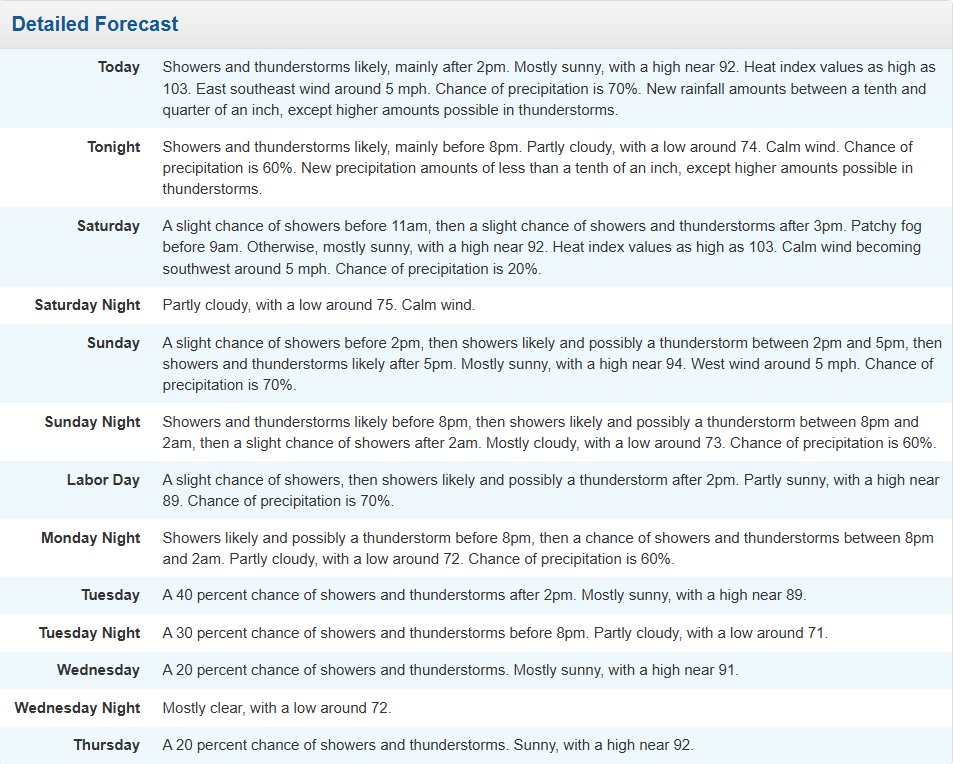
If the pods are holding well and you feel the crop can wait, consider giving it an additional 5–7 days to allow more pods to mature. However, keep the weather forecast in mind. If peg strength is already weak and there is a heavy chance of rain, consider getting the peanuts out of the ground before the soil becomes too wet and heavy. Once the soil gets heavy, digging can put additional stress on weak pegs and increase the potential for pod loss.
Know what is happening under the vines before making the decision to dig.
Remember: It takes 6 of the back end (white) pods to replace 1 of the front end (dark) pods. So don’t put your faith in the back-end crop.
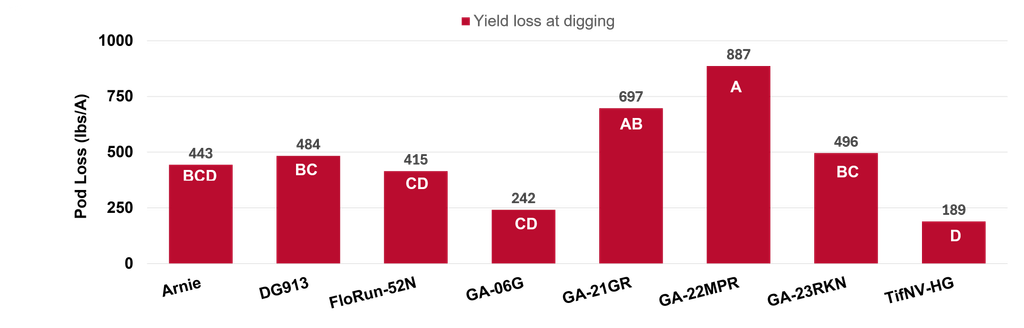
Below is some data from the variety trial last year, showing the pod loss in lbs/A. Keep in mind that these peanuts were inverted at 153 DAP. (May 25th-October 20th)
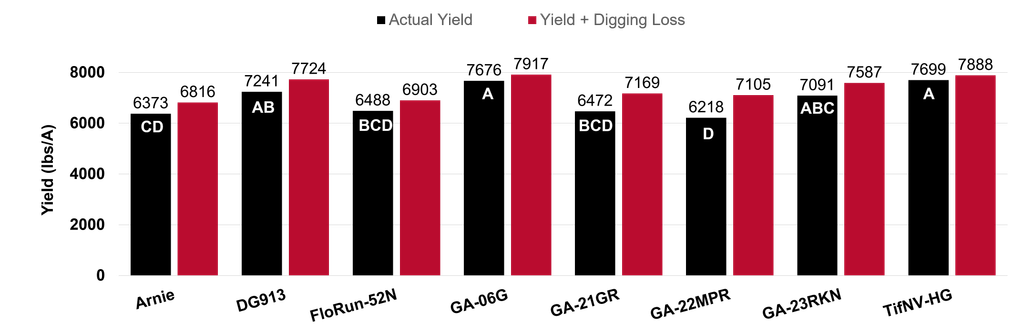
The second graph shows the yield (black bar) and the yield + digging loss (red bar)
Finalizing Peanut Fungicide Programs (Dr. Bob Kemerait, UGA Plant Pathologist)
1. When considering “pre-harvest” intervals for peanuts, some define harvest as “digging date”. I define it as “picking date”. Why does it matter? It may give a grower more options on what can be used.
Scenario 1- two weeks or less until projected digging? The die is cast. You are done. A fungicide now is either too little, too late, or not needed. Or not enough time left to matter. This goes for leaf spot and white mold.
Scenario 2- three weeks until projected digging and all looks good. Little to no leaf spot or white mold? Good job! You are done. Stick a fork in it.
Scenario 3- three weeks until projected Digging. White mold is not an issue, but you have been facing leaf spot. It’s under control, but you are concerned. Use some combination of chlorothalonil + something else with systemic activity. That could be something like Tetraconazole (Domark) or thiophanate methyl (Topsin). Alto (cyproconazole) is an effective measure when you have 40 or more days until picking.
Scenario 4- three weeks until projected digging and losing leaves right and left to leaf spot. Honestly, at this point, it is likely too late for any fungicide to help, even to “buy me some time”. The die is cast. If you insist on spraying, look at scenario 3. But are you wasting money? In scenario 4, you may need to dig early to avoid excessive harvest losses. When defoliation gets beyond 50%, the pods start to abandon ship.
Scenario 5- three weeks to go until projected digging. White mold is present, but suppressed. I would put something about to keep it quiet. That may be some teb with chlorothalonil. It may be some azoxy with chlorothalonil. It may be some Prothio. Something. Cheaper.
Scenario 6- three weeks to go and white mold is off the chain. Houston……. It is a tough situation. Will the cost of a better fungicide pay for itself? How much time is left? Answer- with three weeks to go, I would not, could not, invest in top-tier white mold products, but I would use some combination thst includes prothioconazole. If my budget is shot, put out full rates of teb or azoxy.
Scenario 7-. Three weeks to go and leaf spot and white mold control are good but there is beaucoup mater wilt virus. Stay the course. Do not dig early for tomato spotted wilt.
Scenario 8- four weeks or so to go: no disease problem? Something like Chlorothalonil or teb-chlorothalonil to keep the disease honest
Scenario 9- four weeks or so to go and leaf spot and/or white mold is a threat – consider use of any fungicides. Even top-tier, based on threat vs yield potential vs cost
Scenario 10- four or so weeks to go and disease has gone wild? Take a deep breath, consider digging dates, don’t throw money at a problem money won’t fix.
End of Season – Cotton Irrigation Management: (Dr. Wes Porter- Precision Ag Specialist)
End of Season – Cotton Irrigation Management | Extension Precision Ag and Irrigation
Multiple studies have focused on determining the appropriate timing for irrigation termination and the conclusions from those studies agree that terminating at cutout provides no difference in yield from terminating later in the season. These studies have shown differences from $3/ac up to $85/ac of additional input costs from unnecessary irrigation later in the season.
Thus, based on these studies, irrigation termination from both the yield and profit standpoint have shown that cutout is the optimum timing.

Soybean Harvest Aids, Classic/Florida Beggarweed/Peanuts (Dr. Eric Prostko, UGA Weed Specialist)
1) A few comments about soybean harvest aids/desiccants:
a) General consensus among soybean specialists these days is to wait until R7 stage.
b) I have already written several blogs about this topic
c) A good/recent article from the University of Arkansas (https://arkansascrops.uada.edu/posts/harvest/soybean-harvest-aids-2025.aspx)
d) Soybean stages of growth
https://crops.extension.iastate.edu/encyclopedia/soybean-growth-stages
https://extension.msstate.edu/sites/default/files/publications/P4028_web.pdf
e) Check out Pages 266-267 in 2026 UGA Pest Control Handbook (https://fieldreport.caes.uga.edu/wp-content/uploads/2025/02/SB28-28.pdf)
Key stages to consider include:
- R6: The seed fills the pod cavity but is still covered by a thin white membrane.
- R6.5: The seed is full, round, and shiny, and the white membrane is no longer present.
- R7: At least one normal pod on the upper four nodes of the main stem has reached its mature tan or brown color.
- R7.1: Seeds have begun changing from green to yellow.

2) Classic/Florida Beggarweed/Peanut:
a) I have been getting a ton of questions about the use of Classic for the late-season control of Florida beggarweed in peanut. “Control” is probably not a great word to use in this situation because in reality, late-season applications of Classic really do not provide “control” in the normal sense of the word but do help improve fungicide deposition and harvestabilty.
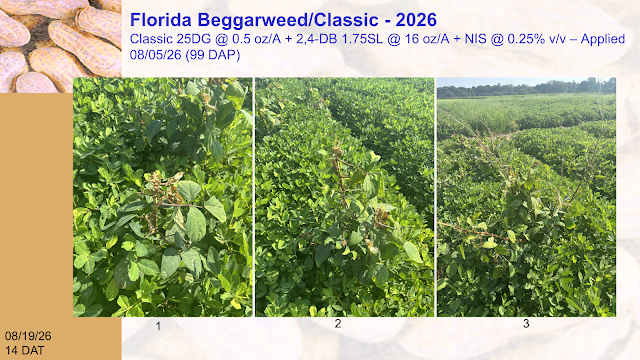
b) Expectations for the success of Classic at this time are dependent on the size of the Florida beggarweed plants that get treated. Simply, the bigger the plants, the less effective Classic will be. I recently applied Classic + 2,4-DB to one of my peanut fields to get a better feel on what actually happens. Basically, the Florida beggarweed plants were stopped in their tracks at the time of application. What this means is that beggarweed plants that were at or slightly above the peanut canopy are now not effecting fungicide deposition. But plants larger than this are. The picture below is of 3 different Florida beggarweed plants in this field that illustrate this point. So, if beggarweed plants are towering above the peanut canopy (Plant #3), probably not worth the effort/expense to apply Classic. Here is what the Classic label says about Florida beggarweed control in peanut: “Apply before Florida beggarweed reaches 10″ in height or begins to bloom”.
c) For more information about the use of Classic in peanut, check out the 2026 UGA Pest Control Handbook, page 225 (https://fieldreport.caes.uga.edu/wp-content/uploads/2025/02/SB28-24.pdf)
d) Other options for Florida beggarweed control in peanut at this time of year include paraquat in a non-selective applicator (weed wiper, rope-wick), mowing, or hand-removal.
All About The Pod Podcast (UGA Peanut Team)